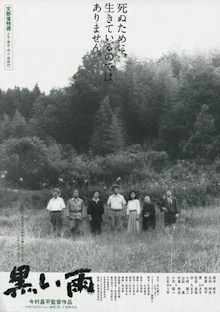
We’ve been working through a decent chunk of the filmography of Shōhei Imamura. Black Rain, released in 1989, is by far the most recent of the lot but as it was shot in black and white, looks as aged as the rest. The subject is of course the atomic bombing of Hiroshima and more importantly its extended aftermath. Watching this, it struck me that I’ve seen wide shots of the bomb going off and the large-scale destruction it causes so many times, but I’ve never seen it from a ground-level perspective like this. The drawn out consequences many years later are depressing but much less dramatic with only a sense of terrible inevitability.
One the fateful day in 1945, Yasuko is outside Hiroshima when she sees a flash of light and the famous mushroom cloud. Returning to the city by boat, she is caught in a rain of seemingly black-colored water. Meanwhile her uncle Shigematsu is on a train when the bomb drops. Lightly injured, he makes it back home to his wife Shigeko. Yasuko joins up with them and together they cross the city to get the factory where Shigematsu works. Five years later they have settled in the countryside. Yasuko is of marriageable age but is spurned by suitors due to fears that she might be unable to give birth to healthy children. As her guardian, Shigematsu struggles against the prejudice to find her a match. They also have to confront the fact that many of their friends and acquaintances are succumbing to the delayed effects of radiation poisoning. Others are unable to overcome their wartime trauma including a young man Yuichi who is triggered by the sound of motor engines.
From innumerable films and shows, we’re all familiar with the sight of the expanding mushroom cloud of a nuclear explosion. These are usually wide shots from a distance, meant to overawe you by the scale of the destruction. Black Rain however gives you the perspective of the victims on the ground. They’re just going about their day as usual when the flash happens and they either die or their lives are irrevocably changed. Extended scenes show the three main characters making their way across the city afterwards, passing burnt and mangled corpses, and horrifically injured victims. One awful scene shows a young boy, his clothing and skin melded together, trying to convince an older one that he is his brother. At various points, they have to duck under live electrical wires, nap in the woods and wade into dirty water. Through it all, you can just hear the Geiger counter ticking in your head though at the time the characters are unaware of the danger of radiation.
The film’s focus is on their lives after the bombing and only occasionally cuts back to the shots of the immediate aftermath. The scenes showing how they are each coping with various health ailments are on point and it makes sense that the hibakusha who all know each other live in close proximity. I do feel that Imamura dwells on Yasuko’s personal plight to an inordinate degree. Shigematsu is outraged on her behalf that she keeps getting rejected despite not being directly exposed to what they call the flash. But Shigeko notes, she was exposed to the black rain and spent plenty of time walking through the radioactive city. Subsequent events prove that the fears of her suitors aren’t unfounded after all, making Shigematsu’s anger feel impotent. I’d have preferred a wider lens on the community as a whole and perhaps a better sense of how they are viewed by the rest of society instead of the narrow focus on Yasuko.
The street-level scenes of Hiroshima immediately after bombing are so shocking that I immediately wondered why I haven’t seen this perspective before. That alone is worth the price of admission. The scenes of the quiet misery of their lives afterwards are to be appreciated but I’d say that there is some misjudgment here on what carries weight and feels meaningful. This isn’t quite as good as I’d hoped it would be but it did motivate me to search for more portrayals of the atomic bombings that stay close to the moments of individual human suffering.