After much vacillation, I have decided to split my gaming related content to a new blog, Knights of the Cardboard Castle. This makes the theme and subject matter of the two different blogs much clearer. This means that henceforth no new posts on games or gaming related subjects will be added to this blog. Calltoreason.org will continue to exist but as I don’t always have interesting things to say on more serious subjects, I expect that it will be updated less often. The old content isn’t going to be moved because after some experimentation, I’ve decided that it will be too much trouble.
Red Faction: Guerrilla
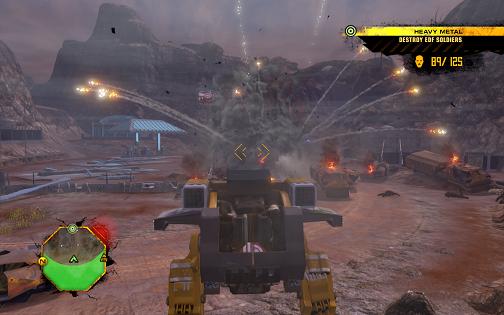
Most shooters start the player off with some kind of assault rifle, maybe a sub-machine gun if the designers are feeling stingy, plus a dinky little side-arm that never actually sees any use. Not so Red Faction: Guerrilla. In this game, right after the introductory cutscene, you’re given a humongous sledgehammer and a satchel of remote-detonated explosives. Then you’re set loose on the Martian landscape to do as you will. That is a fair representation of this game is all about.
You’ll find that most of your time on Mars will be spent wrecking stuff. Of the two starter weapons, the sledgehammer is the more reliable but it’s always satisfying to bring down a building with lots of enemies inside with explosives, especially when you become skilled at identifying structurally weak spots to slap them on. But that’s just the tip of the iceberg that is your arsenal. You also get the grinder, a bulky machine that fires razor-edged metal disks, the thermobaric rocket launcher that is really good at filling an enclosed space with a big explosion, a nano-rifle which infects the target with nanites that dissolve it, and, if you’re lucky, the awe-inspiring singularity bomb, which creates a miniature black hole.
Dominion Cardgame
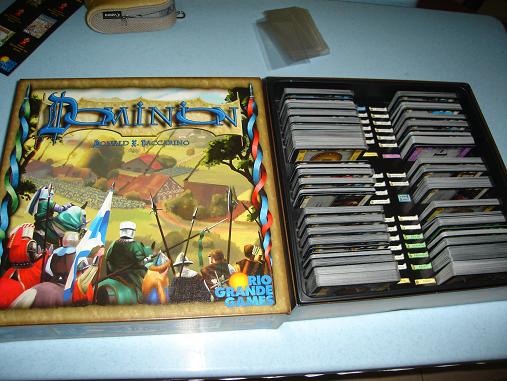
Ever since I first learned to play Magic: The Gathering more than ten years ago, I’ve been a big fan of card-based games. Using cards allows games to get away with a relatively simple core ruleset while adding additional rules and exceptions to the established rules as needed on the cards themselves. This means that while a good player will need to have knowledge of all of the cards and their possible effects, a beginner can start with just the core rules and add to his or her knowledge by reading the cards as they’re played. With a large enough library of cards, you get unparalleled dynamism from all the different card interactions, including many even the original designers didn’t predict, and hence a continuously fresh experience.
One of the things that I’ve always admired about Magic is the abundance of what I like to call meta-cards in the game. Most of the cards in Magic represent summonable creatures, castable sorceries, forgeable artifacts and all of the other accouterments that one would expect in a game depicting a duel between powerful mages, but the meta-cards are none of these. Instead, these cards have effects that manipulate the deck itself, allowing the user to among other things, draw additional cards, retrieve cards that have been discarded, and even go looking into their library for specific cards to put into their hand.
Recent Interesting Science Articles (October ’09)
A bit early this month but I need to make space for more updates next week. The most unusual thing about this installment is that none of the three articles this month are from The Economist! Two of the three articles are about biology while the last one is very speculative, very theoretical physics.
The first of these articles discusses a controversial book about a topic that I’m sure everyone has thought of at one point or another: were our ancestors really faster, stronger and tougher than the humans living today now are? According to the author of Manthropology: The Science of the Inadequate Modern Male, Peter McAllister, the answer is yes. An anthropologist, he bases his conclusions on a wide range of evidence. For example, he examined fossilized footprints of Australian aboriginals who lived 20,000 years ago to estimate their running speed.
Continue reading Recent Interesting Science Articles (October ’09)
Weaver of tales
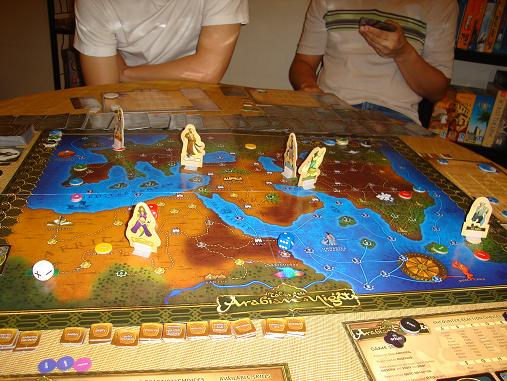
CarcaSean received a shipment of new games last week so everyone was eager to try them out. Of these, Heroscape: Rise of the Valkyrie was easily the most visually impressive with its Lego-like terrain pieces and pre-painted miniatures. The most unusual however was the new edition of Tales of the Arabian Nights which is barely a game at all and can be best described as a more advanced version of the old Choose-Your-Own-Adventure books. Each player takes the role of one of the famous characters from the stories from One Thousand and One Nights and sets off on a grand adventure. The point of the game is not to win per se, but to see what crazy scrapes you get into.
As a game that’s all about telling stories, there’s little in the way of rules. There are no statistics for the characters for example and everyone starts the same except for gender. Everyone does choose three skills to start the game with but that’s pretty much it in terms of differentiation. Victory is determined by collecting Destiny and Story Points over the course of the game and a neat little twist is that each player can secretly decide how many of each they need to win before the game begins, so long as they add up together to 20 points. Due to the randomness and unpredictability of the game however, this is obviously meant more to give an ending to the game rather than awarding victory to a player in the traditional sense.
Thoughts on the 2010 Malaysian Budget
Before I go into my views on the budget, I’d like to express my disappointment with the poor quality of the discourse that I’ve read on the topic over on the LYN forums. Most people over there, including at least one moderator, seem to be basing their evaluation of it entirely on how it benefits or harms them personally, completely discounting its effects on a wider scale. While this is somewhat predictable, I’ve also known LYN to offer intelligent and knowledgeable commentary on important issues in the past which is why this particular disappointment is so galling.
To me the most interesting aspect of the new budget is the re-introduction of the property gains tax. The original announcement of a 30% tax on gains made from the disposal of a property purchased within the first two years of acquisition and dropping down in subsequent years seemed bold and promising to me. Since I’ve long been an advocate of capital gains taxes in Malaysia, I felt that this was overdue even though as someone with someone with significant investments in REITs, this would personally hurt me. I see today however that this has been toned down to a mere 5% tax regardless of length of tenure, which seems pitiful to me.
The other major move that most people are talking about is imposing a RM50 service charge on each credit card issued. Currently, it’s not clear whether this is going to take the form of an explicit tax or a mandatory minimum annual fee but the intent is clearly to rein in the preposterous pace of credit cards issuings in the country. Ordinarily, I abhor government-led social engineering even when I agree with the intent, but in this case I believe that the intervention is mild enough to give it a pass. However, I doubt that this will have any major effect as it will be easy enough for the banks to issue rebates to offset the cost.
The various tax breaks including the increase of personal relief from income tax are obviously designed to win some popularity with the voting public but was it really necessary to also throw in a 1% decrease in the tax rate for the highest income bracket? This looks like a particularly unwise move when the government deficit is expected to rise to record levels. Even if the government insisted on keeping the fiscal taps open for stimulus purposes, it would have a better idea to spend the money on a negative income tax on the poorest Malaysians rather than giving a tax break to the richest. A negative tax would effectively be a subsidy for cheap Malaysian labour which should also help to reduce the incentive for employers to hire foreign labour which so many Malaysians seem to be upset about.
Finally, I think that completely opening the financial sector to foreign equity is a great move. In fact, to those who argue that reducing the top rate of income tax would be useful in attracting top tier talent to the country, I’d argue that levelling the playing field is a far greater incentive. It would be even better if the government had the political capital to do away with silly NEP quotas and restrictions, but this is still a good start.
Overall, I favor an economic policy that concentrates on building the fundamentals for consistent and reliable growth rather than trying to jump start the economy for quick spurts of growth. For this reason, I disagree with the tax exemptions for the Iskandar project and believe that it will only open the door to more cronyism and corruption. A good budget should be fiscally responsible and while I agree that turning the taps completely off at this time would be unwise, I believe that the government has not made enough of a commitment to reduce the deficit in the future and I fear that this could lead to increased inflation expectations in the future.
Avengers Assemble!
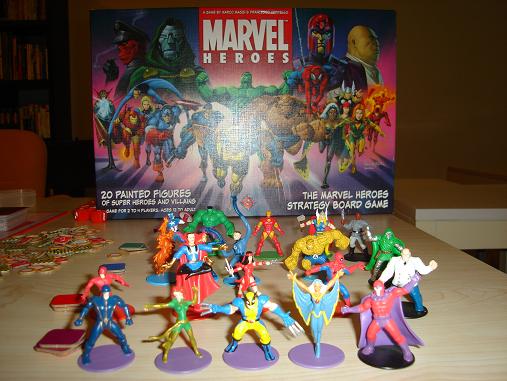
Being somewhat of a fan of superhero comics, I’d noticed the Marvel Heroes box sitting on a shelf on the very first day I stepped into CarcaSean. It wasn’t until much later that I ventured to ask Sean about it. At that time, he told me that he had only played it once himself and didn’t quite understand what the point of the game was. He recommended that I get our resident Ameritrash expert Han to teach the game to me. Even that was quite a while back and only this week did I get a chance to play this out-of-print game with Han, Sean and my wife.
Initially I had the mistaken impression that it was some sort of miniatures-based battle game, perhaps something similar to the Heroclix system. That was incorrect of course as I soon realized after getting into the habit of looking games up on BGG. Instead, pre-painted miniatures notwithstanding, it’s actually a rather abstract strategy game in which the players race against one another to score victory points by resolving various crises. The miniatures aren’t used to track tactical positioning at all and I’d say that the miniature for each team’s mastermind villain doesn’t even have any gameplay purpose.