Anti-vaccination nutjobs

As a skeptic, I’ve never been a fan of alternative medicine or even herbal remedies. I prefer that any medical treatments that I take be experimentally controlled, peer reviewed and statistically compared for efficacy against competing treatments. It feels however that I’m in the minority on this and even people who have a reasonably sound education in the sciences often just state that alternative medicine, while not necessarily being more effective than a placebo, is at least harmless and could provide some psychological reassurance to patients.

Frankly, I feel that this is conceding too much. Even if alternative medical treatments are physiologically harmless, admitting them into the mainstream dangerously blurs the line between truth and falseness. It means conceding authority to snake oil salesmen who claim to not only know better than trained doctors but that doctors aren’t to be trusted because they are in collusion with drug companies who poison patients. More importantly in the long run, it feeds the general perception that scientific truth is not objective and that you don’t actually need any academic qualifications in order to be a respected authority on scientific matters.

Currently the best example of how much damage the anti-intellectual crowd can do is the ridiculous argument against vaccinations. This profile of Paul Offit, a prominent scientist in the development and study of vaccines, in Wired should be required reading for anyone who isn’t convinced that the rise of alternative medicine is actively harmful. It is truly frightening how quickly the fad of parents refusing to have their children vaccinated has grown and how much damage it is already doing. Furthermore, it’s one thing if the parents are harming their own children by not getting them vaccinated, but it’s another thing when you consider that they’re endangering everyone else around them because a good vaccination program depends on everyone being vaccinated to work.

As the article explains, the fears about the risks posed by vaccines are completely groundless and even now diseases that were previously thought to have been vanquished are making a comeback because vaccination rates are dropping. The saddest part is that all this has happened before. In England and Wales in the late 19th century, an anti-smallpox vaccine movement got started causing the disease to flare up even though the vaccine had been invented in 1793. I guess this is what you get when people look to celebrities like Jenny McCarthy, Jim Carey and Oprah Winfrey for scientific advice instead of actual scientists.
Life of a Martian terrorist

rfg 2009-10-18 22-41-56-34_reduced

Is it just me or is there something about Mars that inspires stories about underground resistances against an oppressive authority? The 1990 film Total Recall starring Arnold Schwarzenegger used this theme and it was a recurrent subplot on J.M. Straczynski’s Babylon 5 television series. Even in Kim Stanley Robinson’s Mars Trilogy, the story about the establishment of an utopian colony on Mars quickly turned into one about a protracted guerrilla war against Earth.

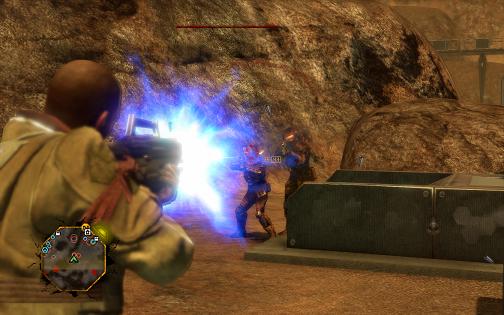
In any case, Volition’s Red Faction series draws from the same wellspring. Its latest offering, Red Faction: Guerrilla is technically the third in the series. However as the first two were only middling successes I gave them a pass. Red Faction: Guerrilla has become quite a hit, especially in the eyes of game critics, plus it’s now an open world game for the first time, which makes it irresistible to me.

Continue reading Life of a Martian terrorist

Zerg Zombies

Starcraft(2)_reduced

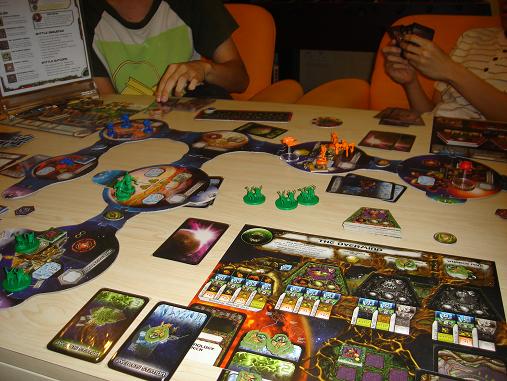
The title is what you get when I try to combine a post about the Starcraft boardgame with a game about zombies. Last week’s in-fashion game at CarcaSean was Starcraft which some of the hardcore regulars played multiple times over the course of the week. I only managed to play once which admittedly isn’t enough to form a good opinion of such a complex game. As its title implies, it’s a boardgame based on Blizzard’s popular video game. As in the original PC version, all three races are represented in the game and there are two rival factions for each race, so that up to two players can choose the same race. Lore-wise, everything is fairly faithful. The two rival factions for the Zerg for example are the Queen of Blades and the Overmind who as any Starcraft fan should know, have little love for one another.

The board for this game is actually made up of interlocking tiles representing star systems that each player takes turns to lay down, which is reminiscent of Twilight Imperium 3. Each system is subdivided into separate areas, each of which offer different resources or conquest points for the player occupying them. The resources, minerals and Vespene gas as in the original game, is spent to purchase technology, build bases and upgrade them and of course build new units. Naturally, the higher tier units can only be purchased once you own the appropriate production building.

Continue reading Zerg Zombies

Saudi Arabia seeks compensation for reduced oil consumption

In a move so outlandish that one would expect to see it only in an Onion article, Saudi Arabia has demanded that if the rest of the world reduces oil consumption due to efforts to combat global warming, it and other oil producing countries should be compensated for the corresponding loss of revenue. That’s about as heinous as drug pushers telling government authorities that they should be compensated if addiction treatment programmes successfully reduce their customer numbers.

While this is the first time I’ve heard of it, it appears that this has been the position of the Saudis ever since the first global climate talks in Rio de Janeiro in 1992. This time however they’re claiming that this is a “make or break” position for them, meaning that other countries must agree to pay compensation for reduced oil consumption or they’re going to walk out of any talks. Of course, Saudi Arabia and other oil producing countries need to diversify away from an economy that’s almost a hundred percent dependent on oil sales, but it’s not clear to me at all why other countries need to pay up to help them achieve that.

The wealth that the oil producing nations have earned from their black gold is already the stuff of legend, so what have they been spending it on if not preparing for a day when oil is no longer king? Furthermore, it’s not as if the oil is an infinite resource. In fact, if anti-global warming initiatives fail to reduce oil consumption, their oil would just be depleted all that much faster. Do they expect the world to compensate them for the loss of that oil then? It’s like asking their customers to pay for the same product twice.

World’s best boardgame!

Puerto Rico (2)_reduced

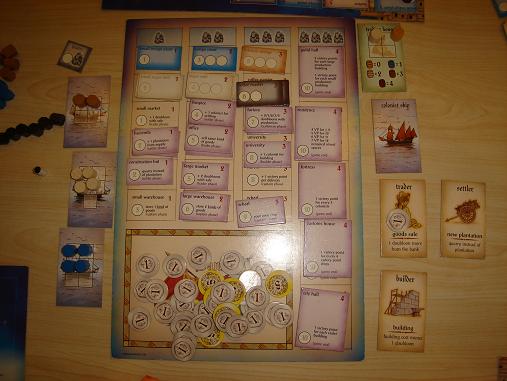
Or it was until recently on the BoardGameGeek rankings anyway. Agricola is currently our favourite boardgame, but since it only recently displaced Puerto Rico from the number one spot which it had previously held for quite a while, I’ve been itching to try the older game. Sean was kind enough to teach to us and join in even though he’s played it plenty of times already. His copy of the game certainly has the wear and tear to show it!

Since we’ve already played Twilight Imperium 3 and Citadels, we’re already familiar with the central mechanic of choosing roles, so we found it to be a fairly easy game to learn. Basically there are a number of roles which gives both the player who chooses the role as well as all other players in the game a specific action. The active player does get a small bonus for choosing the role. Every round that a role doesn’t get picked, money gets added onto it and whoever later picks that role gets it as a bonus.

Continue reading World’s best boardgame!

A Game: Colonization

Colonization 2009-10-04 23-36-11-43_reduced

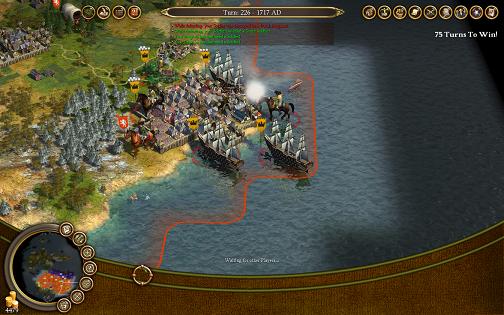
For a game that now claims membership of the Civilization family, Colonization lacks the breadth, depth, variety and sheer richness of its more famous cousins and is the poorer game for it. For one thing, it covers only a narrow slice of history, from 1492 to 1792 to be exact and despite its generic name, it covers only the colonization of the Americas. Folks who might have wanted a game that covers the colonization of Africa or Asia for example will have to walk away disappointed. For another thing, while there are many paths to prosperity, there is only one route to victory: successfully declaring independence from your mother nation and defeating their forces on the battlefield.

You start the game with a motley group of colonists out to make a new life in the New World. Unlike the Civilization games, you get a naval unit as part of your initial force, so you’re expected to spend some time exploring to find the best spot for your first settlement. Again, unlike Civilization, you’ll inevitably find that while the New World is indeed a vast land filled with riches, the best spots are already occupied by the native indians, so there is potential from conflict right from the beginning.

Continue reading A Game: Colonization

A better Risk

Struggle of Empires (2)_reduced

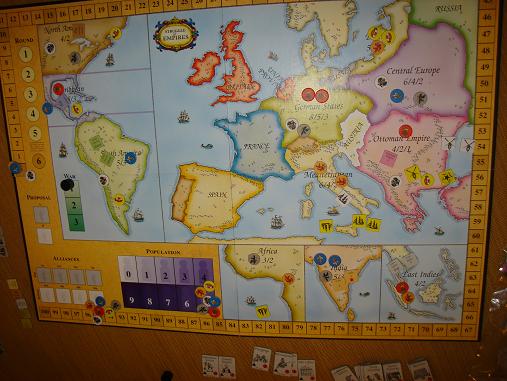
We made an extra visit to CarcaSean in the middle of the week for a session of Struggle of Empires. With six players in all, I do believe that it’s the biggest gaming group we’ve had yet. Our group was led again by Han who taught us the rules which took about half an hour out of our total playing time of four hours. This game’s basic gameplay reminds me a lot of Risk, though it’s obviously a much more subtle and complex game.

The main area of the board depicts Europe while the smaller boxes to the left side and bottom represent the areas that the European powers can colonize. The object of the game is to gain as much influence as possible and this is accomplished by conquest. You move ships and armies around the board to strike and defend as needed while spending your own population to raise new forces. You can also use your actions and money to buy special tiles which confer various advantages and abilities over the course of the game.

Continue reading A better Risk

The unexamined life is a life not worth living