I must confess that I have an irrational attraction to all screenplays written by Charlie Kaufman. Being John Malkovich was weird and silly but a complete delight all the same. Eternal Sunshine of the Spotless Mind is nothing less than one of my favorite films ever. So it was inevitable that I would eventually get around to watching Adaptation, even though it isn’t generally considered to be one of his better efforts. Please note that this post will be chockful of spoilers because it simply isn’t possible to discuss the film in sufficient detail otherwise.
Adaptation is very generally a film whose story is about the story of the film itself as it is being created. As such it is intensely self-referential. The main character of the film is a fictionalized version of Charlie Kaufman himself, played by Nicolas Cage, trying to write the screenplay of the film that would become Adaptation. In the film, Kaufman, following the success of Being John Malkovich, has been hired to write the screenplay for a film adaptation of Susan Orlean’s novel The Orchid Thief.
I’m not sure why Marginal Revolution only just now linked to a Guardianarticle from 2003, but it’s still a seriously good read. The dolphin in the article was trained to help keep her pool clean by bringing any waste paper that falls into her pool to the keepers for a reward. Over time, one of the dolphins learned to trick the humans. Instead of immediately giving a big piece of litter to her keepers, she would hide it and only tear off small pieces to give to a keeper each time one passed, thereby earning more fish as a reward.
What’s even more impressive is that since she has also been trained to bring gulls (I’m not sure if they’re dead or alive at this point) that fly into her pool to the humans in return for a reward, she learned to keep some of the fish that she’d been given. Once the humans went away, she used the extra fish as bait to lure gulls to fly into her pool to catch them so that the humans would give her more fish for the gull. The rest of the article is filled with similarly fascinating anecdotes.
Science-fiction of course has long been full of stories about dolphins being intelligent, the entire plot of the fourth Star Trek film being the most obvious example. But this article lead me to thinking back to opinions of people like Australian SF author Greg Egan, who believes that our current treatment of some animals amount to human rights violations that will one day be recognized as a historically shameful era of our species.
After much vacillation, I have decided to split my gaming related content to a new blog, Knights of the Cardboard Castle. This makes the theme and subject matter of the two different blogs much clearer. This means that henceforth no new posts on games or gaming related subjects will be added to this blog. Calltoreason.org will continue to exist but as I don’t always have interesting things to say on more serious subjects, I expect that it will be updated less often. The old content isn’t going to be moved because after some experimentation, I’ve decided that it will be too much trouble.
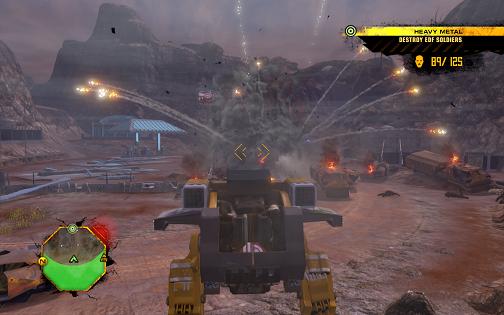
Most shooters start the player off with some kind of assault rifle, maybe a sub-machine gun if the designers are feeling stingy, plus a dinky little side-arm that never actually sees any use. Not so Red Faction: Guerrilla. In this game, right after the introductory cutscene, you’re given a humongous sledgehammer and a satchel of remote-detonated explosives. Then you’re set loose on the Martian landscape to do as you will. That is a fair representation of this game is all about.
You’ll find that most of your time on Mars will be spent wrecking stuff. Of the two starter weapons, the sledgehammer is the more reliable but it’s always satisfying to bring down a building with lots of enemies inside with explosives, especially when you become skilled at identifying structurally weak spots to slap them on. But that’s just the tip of the iceberg that is your arsenal. You also get the grinder, a bulky machine that fires razor-edged metal disks, the thermobaric rocket launcher that is really good at filling an enclosed space with a big explosion, a nano-rifle which infects the target with nanites that dissolve it, and, if you’re lucky, the awe-inspiring singularity bomb, which creates a miniature black hole.
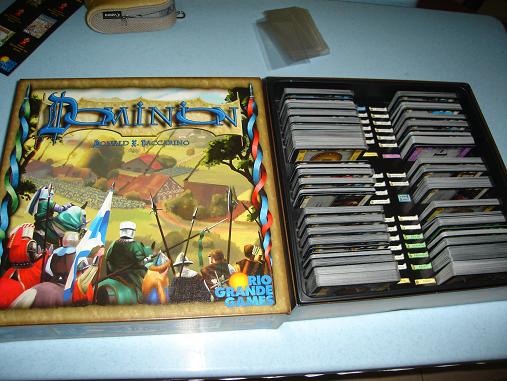
Ever since I first learned to play Magic: The Gathering more than ten years ago, I’ve been a big fan of card-based games. Using cards allows games to get away with a relatively simple core ruleset while adding additional rules and exceptions to the established rules as needed on the cards themselves. This means that while a good player will need to have knowledge of all of the cards and their possible effects, a beginner can start with just the core rules and add to his or her knowledge by reading the cards as they’re played. With a large enough library of cards, you get unparalleled dynamism from all the different card interactions, including many even the original designers didn’t predict, and hence a continuously fresh experience.
One of the things that I’ve always admired about Magic is the abundance of what I like to call meta-cards in the game. Most of the cards in Magic represent summonable creatures, castable sorceries, forgeable artifacts and all of the other accouterments that one would expect in a game depicting a duel between powerful mages, but the meta-cards are none of these. Instead, these cards have effects that manipulate the deck itself, allowing the user to among other things, draw additional cards, retrieve cards that have been discarded, and even go looking into their library for specific cards to put into their hand.
A bit early this month but I need to make space for more updates next week. The most unusual thing about this installment is that none of the three articles this month are from The Economist! Two of the three articles are about biology while the last one is very speculative, very theoretical physics.
The first of these articles discusses a controversial book about a topic that I’m sure everyone has thought of at one point or another: were our ancestors really faster, stronger and tougher than the humans living today now are? According to the author of Manthropology: The Science of the Inadequate Modern Male, Peter McAllister, the answer is yes. An anthropologist, he bases his conclusions on a wide range of evidence. For example, he examined fossilized footprints of Australian aboriginals who lived 20,000 years ago to estimate their running speed.
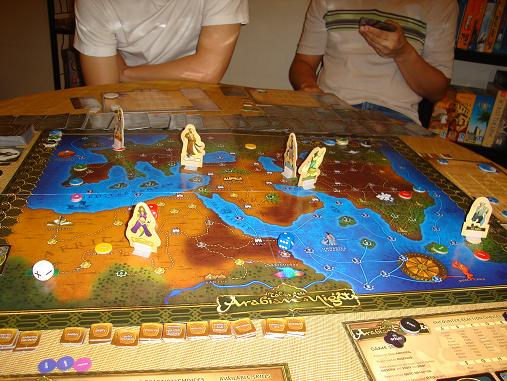
CarcaSean received a shipment of new games last week so everyone was eager to try them out. Of these, Heroscape: Rise of the Valkyrie was easily the most visually impressive with its Lego-like terrain pieces and pre-painted miniatures. The most unusual however was the new edition of Tales of the Arabian Nights which is barely a game at all and can be best described as a more advanced version of the old Choose-Your-Own-Adventure books. Each player takes the role of one of the famous characters from the stories from One Thousand and One Nights and sets off on a grand adventure. The point of the game is not to win per se, but to see what crazy scrapes you get into.
As a game that’s all about telling stories, there’s little in the way of rules. There are no statistics for the characters for example and everyone starts the same except for gender. Everyone does choose three skills to start the game with but that’s pretty much it in terms of differentiation. Victory is determined by collecting Destiny and Story Points over the course of the game and a neat little twist is that each player can secretly decide how many of each they need to win before the game begins, so long as they add up together to 20 points. Due to the randomness and unpredictability of the game however, this is obviously meant more to give an ending to the game rather than awarding victory to a player in the traditional sense.