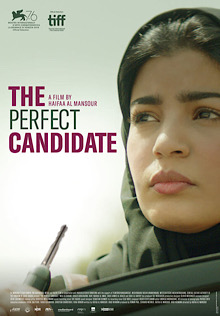
We’d previously seen the breakout film Wadjda by the Saudi Arabian female filmmaker Haifaa al-Mansour. This one is naturally another film about female empowerment in the kingdom focusing on perhaps the ultimate form of it, participating in its politics. It actually seems to take place in a better environment for women under a government that is trying to enact some reforms and so isn’t quite as depressing. By taking on elections, this isn’t just a more serious subject that buying a bicycle but gives us a better look at the lives of adults in the country.
Every inch the modern, well-educated Saudi Arabian woman, Dr. Maryam Alsafa drives her own car and works at the local hospital. She is frustrated however that the road leading to the hospital is unpaved and becomes muddy in the rain, making it difficult for patients to access. Some male patients also refuse to be treated by a female doctor, preferring male nurses to tend to them even if that results in worse care. Hoping to get a job at a better hospital, she registers for a medical seminar in Dubai, paying for it with a loan from her photographer sister Sara. But she is stopped at the airport as being an unmarried woman, her father must approve her travel and the government has switched to a digital permit system. Meanwhile her father Abdulaziz, a music teacher, is busy on tour performing for the first time with the support of the government. Maryam tries to get a male cousin Rashid to approve her exit permit but while getting in to see him has to register as a candidate for the local elections. In the end, she never gets to go to Dubai but decides to be serious about getting elected to fight to get the road to the hospital repaired.
The plotting is convoluted, being deliberately engineered to highlight several different aspects of life in the country. So it’s a little strange that Maryam has to attend a conference in Dubai in order to apply for a job in Riyadh and it just so happens that her normally supportive father is unable to help her as he’s off pursuing his own dreams just right then. Then at a wedding where her sister is working, she runs into Omar, the nephew of the patient who angrily rejected her treatment but has the right experience in handling audiovisual equipment to help her election campaign. That’s an awful lot of convenient coincidences. The actors here aren’t the best either and while Maryam runs into obstacles, everything turns out okay just a bit too easily to be believable. It has been pointed out this is a sanitized view of Saudi society and in a way this could be construed as propaganda. It was made with the support of the Saudi government and puts on a positive spin on the Crown Prince’s modernizing reforms. So Rashid as a government official is enthusiastic about Maryam signing up to be a candidate but it is some of the conservative citizens of the kingdom who are the problem.
All the same, even this biased perspective on Saudi society is invaluable to us outsiders. It’s shocking how the dress codes for men and women in public result in them all but having uniforms. But in women-only private spaces, such as the weddings depicted here, they’re free to let down their hair and show off a wide variety of fashion styles. The joy that Abdulaziz and his fellow band members take in performing music live is a stark reminder just how lacking in entertainment options Saudi Arabia was until very recently due to religious objections. We probably all know about the obligation to segregate men and women but here we can see the silliness firsthand when Omar needs to fix a microphone malfunction during a wedding but isn’t allowed in the women-only tent. When Maryam starts making TikTok style campaign videos wearing a niqab that covers her most of her face, the youngest sister Selma complains that men can still see her eyes. So she covers them as well. Throughout the film, Selma acts as the contrarian, upset that Maryam’s activism will bring shame and gossip to the family. It’s a pity then that this particular subplot is never resolved.
If it weren’t for the Saudi Arabian setting and how exotic it still is for international audiences, this would probably only be about average. Maryam’s dialogue is didactic rather than emotive so the film feels too much like it wants to make a point. It did decently well on the festival circuit and the Saudi government crowed about it so it seems to me that this was made to change the minds of the international community that the country is in much better hands now. I’d have loved to know how widely watched it was in the kingdom itself and what the response was. I’d still consider it worth watching simply because of its uniqueness.