This one is a mostly Spanish language animated film that is credited to a trio of directors who are probably little known outside of Spain. As usual for animated films, my wife picked this one and she must be glad for it since music figures heavily in it, especially the music of Cuba and the way it came to influence the world of jazz. It’s also an animated film that is definitely not kid-friendly since it is unashamedly erotic. Together, these elements make this a rather unique and interesting film.
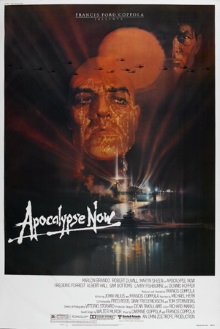
As a film that pops up often near the top of lists of the best movies ever made, Apocalypse Now surely needs no introduction. Together with the Godfather trilogy, this established Francis Ford Coppola’s reputation as one of greatest American directors of all time. The version we watched is the much longer Redux edition that was released in 2001. It’s actually getting rather difficult now to find the original theatrical version.
Still mostly biology this month though the most visible bit of news is space stuff.
This being NASA’s announcement that its Mars Reconnaissance Orbiter (MRO) has discovered liquid water on the planet’s surface. The water involved is highly briny, which helps keep it liquid at low temperatures, and even so it only flows seasonally when it’s not too cold. Plus, of course, we’ve long known that water already exists on Mars in the form of ice and ancient water deep beneath the surface. Still it’s a significant milestone that will reinvigorate the search for life on the red planet. I suspect that this will also cause NASA to be much more careful about contaminating Mars with microbial life from Earth.
But the most significant finding over the past month is probably this paper about a new species of the homo genus found in Africa. Now dubbed homo naledi, they are represented by fossils found of at least 15 distinct individuals in South Africa. The discovery was originally made in 2013 but it has taken until now to fully study the fossils and the researchers’ conclusion is that the unique morphology of the specimens warrant classifying them as belonging to a hitherto unknown and now extinct specifies of humanity. Early reporting of this paper excitedly emphasized that they may had culture as the fossils were all found together is what is thought to be a burial site. This is a shock given that this should date from long before any form of civilization. But I’m dubious about this since it’s also possible that it was just a convenient place to dispose of trash.
Moving on to more sci-fi stuff, DARPA announced the development of neural technologies that allow patients to experience sensation from prosthetic limbs. This is rather crude at the moment as the connection is formed with electrode arrays on the patient’s and sensory motor cortex to torque sensors on an artificial hand, allowing the patient to both feel and control the individual fingers of the hand. Basically it amounts to a proof that cybernetic limbs that can transmit a sense of touch are possible.
Finally, this Naturearticle talks about how a genomics firm in China is now offering gene-edited pigs for sale to the public as pets. These pigs have been modified to disable one of two copies of the growth hormone receptor genes that they possess, so that instead of their normal weight of around 35 to 50 kilograms, they will grow only to about 15 kilograms. The company also claims that in the near future, they will offer versions that can be modified to have different coat colors and patterns. But as the article notes, pigs’ size are not the only reason why they are not generally raised as household pets and owners who expect to be able to house train them will end up being disappointed.
This is the second film we’ve watched by Wim Wenders and while it also stars Bruno Ganz, it really couldn’t be more different from The American Friend. It was made a decade after the other film but actually looks and feels much older partly because most of the scenes are shot in black and white and partly due to its style and subject matter.
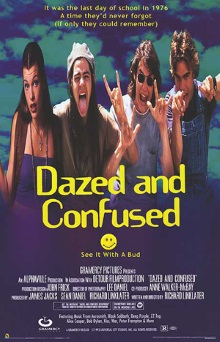
That this was directed by Richard Linklater is probably reason enough to watch it, but it’s also one of those high-school coming-of-age movies that went on to become a cult favorite. As one of Linklater’s earliest movies, it’s apparently the first one to have any recognizable stars in it even if most of them were unknowns when they appeared here. Watch out in particular for a very young and slightly chubby Ben Affleck in a supporting role.
Black Coal, Thin Ice is an unusual and evocative title. Unfortunately it also has nothing to do with the film’s Chinese title which translates literally as Daylight Fireworks, a phrase that is relevant in the story in at least a couple of instances but is less poetic in English. The discrepancy is notable enough that director Diao Yinan addressed it but I’m not sure that his explanation makes much sense. At least this choice suggests that he has a good sense of aesthetics, as the film itself aptly proves.
For the benefit of everyone who isn’t an expert on insects, let me just say that this film has nothing to with dukes or the region of Burgundy. Instead, the title of this film refers to a specific species of butterfly. Since this never gets said in the movie itself, I had to go and look it up. What this film is about is the sadomasochistic relationship between two women with insects, butterflies and moths in particular, being a recurrent theme.