This one is a highly acclaimed documentary shot by two journalists, Sebastian Junger and Tim Hetherington, while they were embedded with a US Army unit over the course of a 15-month deployment in Afghanistan from 2007 to 2008. Unless you’re familiar with the events in question, the meaning of the title must be deliberate bit of mystery that is revealed later in the film itself.
This is an older Brazilian film by Walter Salles and I’ve written about his work before. He directed one of the segments in Paris, je t’aime, one of my favorite ones actually about an immigrant needing to travel far from home to get to work in Paris. He also directed the acclaimed Motorcycle Diaries which my wife watched but which I missed because I wasn’t much interested in films back then. On the other hand, I’ve also watched his Hollywood remake of Dark Water, which is as awful as these adaptations of Japanese horror films generally are. That’s quite a leap in terms of style and quality!
This one was hot stuff on Broken Forum for a while and I thought that the idea of combining substances in a factory to make pharmaceutical products was pretty novel. It’s really just a matter of running the inputs through the correct sequences of machines and it plays out on a two-dimensional factory floor, so it’s not anything too complicated. With all of the conveyor belts going everywhere and the strange shapes of the machinery, there’s even a Rube Goldberg quality to the art style.
This is lighter weight fare added to our list by my wife. I’ve never watched this before but even the original 1940 Fantasia doesn’t hold much prominence in my mind. It was just too far before my time and the only thing I remember of it is the one that everyone knows: the Sorceror’s Apprentice segment. Fantasia never did make much money for Disney but it was apparently very important for many people in the company as an early showcase of what animation can achieve. Fantasia 2000 was therefore a sequel that was in germination for a very long time and this time, as is appropriate, it brings computer generated graphics to the table.
I like to give Indian cinema a fair shake but more often than not we’ve been disappointed by them. By and large, their insistence on song and dance numbers, no matter how incongruent, their simplistic storylines and above all their excessive lengths often make them quite a chore to watch, as my wife is wont to complain. It just seems stupidly difficult to identify serious Indian drama to watch. Though Udta Punjab also shares the trait of being somewhat long, it’s mostly an exception as I’m happy to report. It was a recommendation that I read about from The Economist, though as an article about the drug problem in Punjab rather than a film review.
Well, this has certainly been a tumultuous month in terms of politics. In terms of science, though it started out a bit slow, plenty of interesting stuff came out in the past couple of weeks.
Over the long term and on a global scale, probably the biggest harm the Trump presidency could cause is in rolling back measures to tackle climate change. Fortunately the latest news is that there seems to have been a recent pause in the growth rate of atmospheric carbon dioxide. The upshot is that human industry is emitting more of the stuff than ever before, but it seems that carbon sinks have also been absorbing more of it than expected. It isn’t at all clear what is happening but the leading theory is that plants seem to be increasing their absorption of carbon dioxide in response to higher concentrations of the gas and higher temperatures.
Also due to the recent elections, Facebook has been in the news due to its dissemination of fake news. This article covers a study in Denmark which shows that quitting Facebook seems to make people happier. Previous papers of this nature have been published before but this one involves a randomized controlled trial of more than a thousand participants recruited via Facebook itself in which half of them were randomly instructed not to use the social network for a week and the other half were instructed to continue their usual browsing habits. The effect was small but those who changed their habits did indeed seem to become happier.
The most important science article however must be this New York Timesfeature arguing that growing usage of genetically modified crops seems to not have led to increased yields, nor to reduced usage of pesticides. They came to this conclusion by studying aggregate data about crop yields and pesticide usage in the United States and Canada, where genetically modified crops are common to Europe, where they are generally banned. Many commentators have since pointed out that this isn’t comparing like to like since, as you might expect, agricultural conditions within just the United States itself, vary considerably from place to place. Furthermore, decisions on what to grow come from farmers themselves and there must be good reasons why farmers, when given the choice in North America, tend to choose genetically modified crops even though those seeds are more expensive. Nonetheless, regardless of which side you take, this is an important piece of a conversation that is still ongoing.
Moving on to better news, here’s one about the discovery that rates of dementia in the United States seem to be falling despite the fact that some of the risk factors associated with the disease, such as diabetes, are increasing. Researchers have no idea why dementia rates are falling and can only speculate that it might be linked to more education or higher cognitive demands being placed on the brain. Some commentators have instantly named this as another kind of Flynn effect.
The most exciting news of course is the one about the EM drive. I’ve talked about it before, but to recap, it’s a reactionless space drive that requires no propellant and so seemingly violates Newton’s Third Law. A NASA team has just published a peer reviewed paper confirming that they’ve managed to detect the device generating net thrust in a vacuum. This is huge but most commentators are still skeptical and this Reddit discussion thread provides a decent summary of some of the objections. On balance, it’s still likely that this is due to experimental error but if this checks out, quite a bit of known physics will need to be redone.
Finally, here’s a paper with a very politically incorrect conclusion. Please note that this is a non-peer reviewed paper that has been released for discussion only. It examines upward mobility of Asian Americans, showing that the group suffered plenty of discrimination, both institutional and otherwise, and yet by the 1970s or 1980s had caught up to white Americans in terms of income. The argument is that market forces subverted the discrimination as the wages of Asian Americans, despite work performance at similar levels as white Americans, were artificially depressed by the discrimination so that whichever company hired them would gain a competitive advantage. Over time, this eroded the discrimination itself. The corollary then is that black Americans did not experience similar convergence of income levels because their skills and abilities in the workplace truly aren’t, for whatever reason, as valuable, hence in their case the discrimination is exacerbated by market forces.
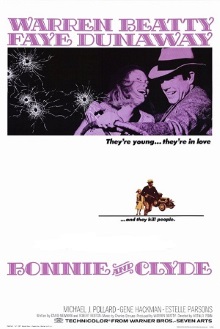
Crime spree films featuring a couple, usually a man and a woman, going off on a wild ride of robberies and killings until they die in a hail of bullets are common enough to constitute a genre in of themselves. Bonnie and Clyde is far from the first of these films but it’s easily the first one that comes to mind when you think about them, especially for American audiences. It’s also one of the earliest American films to show a very obvious French New Wave influence, sharing remarkable similarities in particular with Jean-Luc Godard’s Breathless.